
Approved by the Standards and Outcomes Committee of the Trust Board, March 2020
All learners in our academies will experience a curriculum that
-
- is ambitious and enjoyable through knowledge and skills developed from Foundation Stage to Post 16 and Adult provision.
- is knowledge rich, ensuring access to a wide, global cultural capital – thus maximising lifetime opportunities.
- is inclusive, nurturing and tailored towards the needs of the individual.
- is focused on developing the very best literacy, numeracy and digital skills – enabling access to the widest learning and the very best careers possible to ensure we develop global citizens.
- is enriching, ensuring all experience a rich variety of cultural, artistic and sporting activities.
- is broad in terms of coverage and (at least) encompassing the breadth of the 2014 English National Curriculum.
- celebrates the uniqueness of each educational setting in terms of localised knowledge and skills.
- develops character, personal pride and the highest moral standards.
- celebrates diversity, challenges injustice, promotes equality and encourages the creation of a better world.
- Is delivered by well-qualified, forward-thinking, skilled, passionate professionals.
Intent:
Motto: Together we will succeed
The curriculum at Jubilee Academy is designed to provide a broad and balanced education that meets the needs of all children but goes above the expectations of the National Curriculum by providing an exciting enriching curriculum. It provides opportunities for children to develop as independent, confident and successful learners, with high aspirations, who know how to make a positive contribution to their community and the wider society.
The curriculum has been designed to ensure academic success, creativity and enjoyment whilst also developing the learner as a confident, empathetic unique individual. We have a clear focus that the whole child is also about developing physical development, well-being and mental health whilst promoting a positive attitude to learning. The curriculum is supported by, a wealth of hands-on experiences and educational visits, underpinned by key outcomes.
We endeavour to build strong links with parents as we value their input as partners to enhancing their child’s education aiming to actively engage them in both their child’s learning and wider Academy life.
The curriculum is responsive to, and celebrates the diversity and utilises the skills, knowledge and cultural wealth of the community while supporting the children’s spiritual, moral, social and cultural development, ensuring that children are well prepared for life in modern Britain.
Implementation
Reading
Children in EYFS, KS1 and some children in KS2 who need phonics support are taught using Read Write Inc, which helps them to learn how to read and write their letters and sounds. Children are taught to read using a range of phonetically decodable books. Once children’s phonic knowledge is secure they choose from a range of texts which are book banded according to the level of difficulty. Lexia is used as an additional intervention.
In KS2, Whole class reading is used to build upon this basis and encourage confident and fluent reading. Reading texts are linked to topics where possible, which also aids comprehension work and understanding of reading materials.
We track children’s progress in reading throughout school and ensure there are opportunities for them to read to adults, hear adults read and immerse themselves in quality texts through class libraries, school libraries as well as celebrating reading with our reading vending machine.
Our school, is also part of the World of Books project which has allowed our children the opportunity to further enhance their reading curriculum through diverse books which excite and engage children.
Reading Plus at Jubilee Academy
Developing Confident, Fluent and Independent Readers
At Jubilee Academy, we are committed to ensuring every child becomes a confident and enthusiastic reader. As part of our reading provision, pupils access Reading Plus, an adaptive online reading programme designed to improve fluency, comprehension, vocabulary and reading confidence.
Reading Plus provides a personalised learning pathway for each pupil, ensuring they are working at the right level and making continuous progress. The programme adjusts to individual needs, helping children to develop the skills required to become successful readers both in school and beyond.
How Reading Plus Supports Learning
Through regular use of Reading Plus, pupils develop:
- Reading Fluency – improving speed, accuracy and stamina when reading.
- Reading Comprehension – strengthening understanding and interpretation of texts.
- Vocabulary Development – exposing pupils to a wide range of ambitious language.
- Independent Reading Skills – encouraging pupils to read with confidence and resilience.
- Critical Thinking – helping pupils analyse information and make meaningful connections.
Personalised for Every Child
Reading Plus uses intelligent assessment and ongoing monitoring to create a bespoke reading journey for every pupil. This ensures that children experience appropriate challenge while celebrating success and building confidence.
For our pupils, this personalised approach helps:
- Close gaps in learning.
- Support reluctant readers.
- Build self-esteem and motivation.
- Develop a love of reading.
- Prepare pupils for future learning across the curriculum.
Working Together
We encourage pupils to access Reading Plus regularly both in school and at home. Consistent engagement helps children make the greatest progress and develop positive reading habits.
Parents and carers play a vital role by encouraging children to talk about what they have read, celebrating achievements and supporting regular reading practice.
Writing
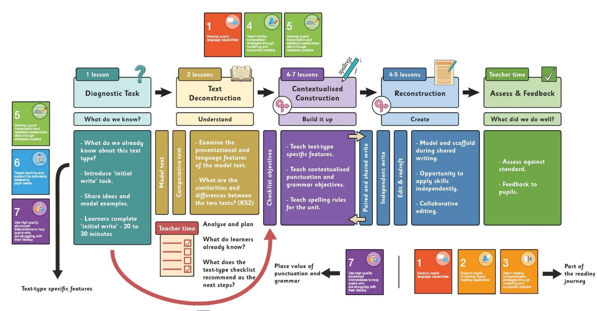
At Jubilee Academy Mossley, children study a range of different writing genres – many of which link to their learning across other areas of the curriculum. Teachers plan using a ‘plan backwards’ approach which enables children to become fully immersed in the genre that they are studying and become secure in the grammatical features of each text type.
Children begin each writing unit by reviewing their previous knowledge of text types and studying ‘model texts’ (which have been specifically designed by Grammarsaurus to link to our wider curriculum) and a range of high-quality literature. Teachers use these texts to teach grammatical, presentational and language features of different genres. Children become more adept in identifying and constructing their own writing using these features. Writing lessons will usually follow the structure of:
- Diagnostic tasks – to assess previous knowledge of the text type
- Text deconstruction – to allow children to be immersed in the text type and identify key grammatical, presentational and language features
- Contextualised construction – to enable children to learn and applying specific features of the text type in shorter bursts of writing
- Reconstruction – to enable children to compose, construct and create their own writing in the style of the model text.
- Assess and feedback – to allow teachers to assess progress in writing linked to the key features of the text type and give children the opportunity to edit and improve their compositions based on feedback.
Resourcing and coverage
Through use of Grammarsaurus we have mapped the coverage of the entire English Programme of Study for KS1 and KS2. In many cases objectives are covered more than once and children have opportunities to apply these several times over the course of a year, as well as to consolidate prior knowledge from previous years. We believe strongly that children should be secure in applying the skills of curriculum 2014 within their writing and their reading and that this approach is fully comprehensive. Where needed, planning sequences are adapted, personalised and differentiated by the school to ensure all access arrangements can be made to support children with the requirements.
Children’s work books
Children present all English skills within their English books or online portfolio. These tools evidence the journey of skills that the children have been learning in order to produce a piece of extended writing. This extended writing will then be published in the ‘Journey of a Writer’ book. The ‘Journey of a Writer’ book will follow the child through school to show the progress and journey of writing the child has been on.
Handwriting is taught at daily following the Handwriting Policy and using the Nelson handwriting scheme.
Spelling is also taught daily from Year 2 following using the Grammarsaurus Morphology programme.
Maths
Within Reception and KS1, we use Mastering Number. This programme will support pupils to develop good number sense and ensures all pupils have the best start in life.
Years 3-6 use the White Rose Maths schemes of learning as their medium-term planning documents. These schemes provide teachers with exemplification for maths objectives and are broken down into fluency, reasoning and problem solving, key aims of the National Curriculum. They support a mastery approach to teaching and learning and have number at their heart. They ensure teachers stay in the required key stage and support the ideal of depth before breadth. They support pupils working together as a whole group and provide plenty of time to build reasoning and problem- solving elements into the curriculum.
Work is completed either in Math’s journals or on our online platform (Magma Maths).
Wider Curriculum
At Jubilee Academy, we use the Primary Knowledge Curriculum to support the delivery of our teaching and learning of the wider curriculum. Our ‘Jubilee Journey is well-planned, coherent curriculum which focuses on developing the children’s wide range of knowledge, skills and understanding in a clear progressive way.
We aim to have high expectations of our children to work hard and demonstrate positive learning behaviours to maximise their individual learning potential. SMSC and Cultural Capital are ‘golden threads’ which we aim to include at the heart of the curriculum we deliver, to closely meet the needs of our pupils.
We offer a wide range of enrichment opportunities and educational visits which are carefully chosen and planned to deepen understanding and to enhance hands-on, exciting and engaging learning experiences. Children from across the school have access to a wide range of extra-curricular activities in both sport, music and the creative and performing arts.
Continuing Professional Development for all staff is currently a priority to ensure they have the necessary skills and knowledge to deliver the highest standards across the entire curriculum. Subject Leaders are becoming increasingly expert in playing a pivotal role in both the design and delivery of their subject area; ensuring a clear progression of both skills and knowledge across all year groups. They aim to articulate how learning is re-visited and developed year-on-year, to ensure a real depth of learning right across the school.
Some subjects (Computing, PSHE, PE and RE) are taught outside of the Primary Knowledge Curriculum but teachers make cross curricular links with these where possible. Class timetables are organised so that there is adequate time given to all curriculum subjects.
All curriculum subjects are presented in the child’s curriculum books or in the case of RE and PSHE a class floor book. History, Geography, Science, French, Art and Design will be presented in journey books that will stay with children through school to show the progression of skills and knowledge that has been learnt.
Schemes of Work:
Primary Knowledge Curriculum
White Rose Maths
Purple Mash
Jigsaw
Grammarsaurus
Nelson Handwriting
Read Write Inc
Striver